
The right rug size for a small living room depends on the seating area, rather than the room’s label. Look for a rug that reaches beneath the front legs of the main seats without crowding doors. A 5-by-8-foot rug may fit a compact grouping; a wider sofa or a facing chair can call for more coverage.
Before ordering, compare the rug’s outline with the furniture you already own. An extra foot along one edge can change whether a chair belongs to the group or sits outside it.
Start the rug outline at the sofa and chairs
Your sofa gives the rug a useful reference point. Room & Board’s design guide suggests a rug slightly longer than the sofa, with roughly 8–12 inches (20–30 cm) beyond each side. Its small-space layouts also suggest resting the front sofa or chair legs on the rug. Treat those as design guidelines, then check your own furniture.
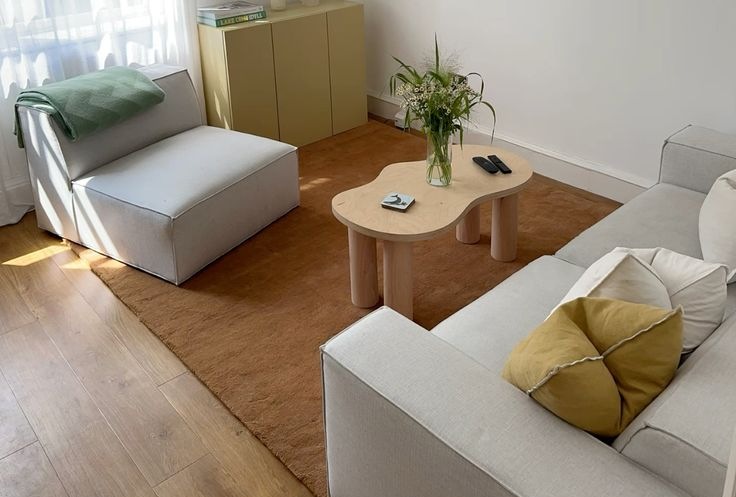
A front-legs placement lets a wall-side sofa share a rug with the coffee table while leaving its rear legs on the floor. When a chair faces the sofa, include that chair in the outline. A rug that stops at the table may leave the seating looking disconnected.
The woven rug below extends across the space between a pale sofa and a green chair. The coffee table sits within that shared area, rather than on a separate patch of floor.
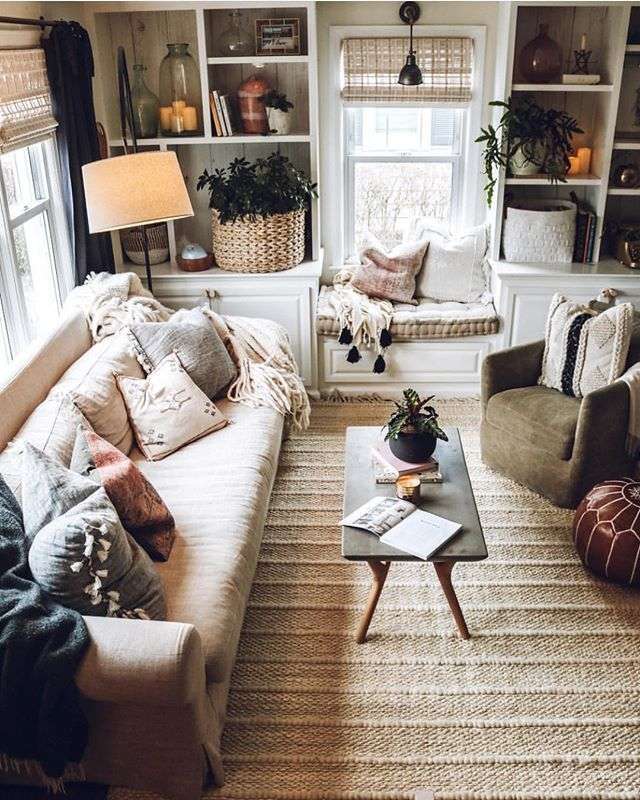
Choose the furniture positions before deciding the rug size. If the sofa itself is still undecided, our guide to choosing a sofa size covers that larger piece first.
Compare 5×8, 6×9, and 8×10 rugs on your floor
Once the seats have a place, compare candidate rug outlines against them. The sizes below are starting points to try, rather than promises that a particular size will fit every small room. Product dimensions can vary, so check the listed measurements before buying.
| Rug size | Approximate metric size | What to check in a small living room |
|---|---|---|
| 5 by 8 feet | 1.52 by 2.44 m | Can the longer edge span the sofa, and can the rug reach the front legs? |
| 6 by 9 feet | 1.83 by 2.74 m | Does the extra width connect a chair without pushing an edge into a doorway? |
| 8 by 10 feet | 2.44 by 3.05 m | Can the broader footprint hold the seating group while leaving doors usable? |
Consider an example sofa that is 84 inches (213 cm) wide. Centering it along a rug’s 8-foot edge leaves 6 inches (15 cm) beyond each end. Along a 9-foot edge, the same sofa has 12 inches (30 cm) at each end. That is a width comparison; rug depth and chair placement still need checking.
A deep chair opposite the sofa may drive the choice more than the sofa’s width. Conversely, buying the larger rug adds little if most of it disappears beneath furniture while an exposed edge interferes with a door.
Turn the rug before ruling out a narrow room
A candidate that feels too wide may work when turned, because rotating a rectangular rug swaps the sides facing the sofa and the room’s length. Compare both orientations with the seats in place. Keep the rug aligned with the seating group rather than centering it automatically between the room’s walls.
In a living room that also contains a desk or dining spot, the rug can belong to the sofa area alone. Extending it beneath unrelated furniture can make the footprint harder to fit. An uneven strip of exposed floor is acceptable when that strip serves the route through the room.
Color is a separate decision from coverage. Our teal and gray living room ideas show ways to carry a palette across furnishings; choose that palette after the rug outline works.
Check rug edges at doors and moving furniture
An outline on the floor checks width and length, but the rug and pad also add height. Check their combined thickness against any door that swings over them. A thin outline alone cannot establish that clearance.
Before committing, open nearby doors and pull out any furniture you regularly move, such as an ottoman. Notice where your feet land when getting up from the sofa. If an edge repeatedly gets in the way, adjust the rug position or compare another size.
Keep the existing furniture layout during this check. Shifting a chair into an awkward position just to make its legs reach the rug solves the drawing while making the room less comfortable to use.
Keep a smaller rug only if its role still works
If you already own a small rug, decide whether you like it as a separate accent in front of the sofa. A rug does not have to connect every seat to be worth keeping, but that smaller placement will look different from a rug that groups the furniture together.
Here, the patterned gray rug sits in front of the dark sofa, with wood floor between its edge and the sofa legs. The photograph shows that separate placement clearly; it does not establish the rug’s actual dimensions.
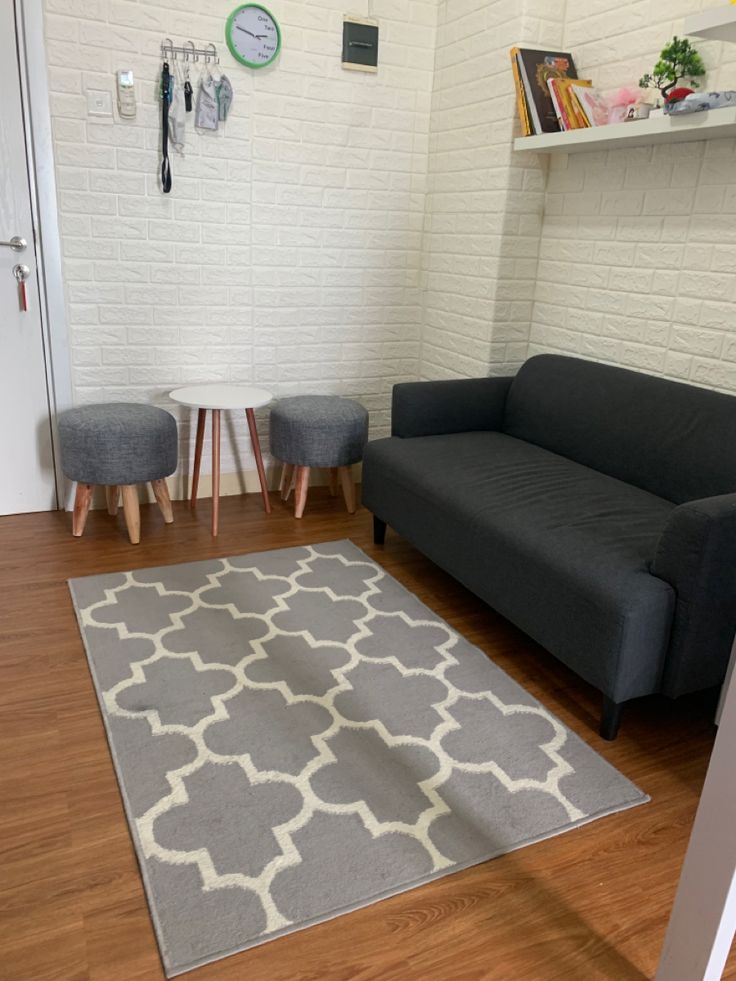
Try moving an existing rug before replacing it. Bringing one edge beneath the sofa may improve the connection, though the opposite edge will move closer too. If that leaves too little rug around the table or facing chair, compare a larger outline instead.
Choose the size whose edges work with the seats, doors, and floor you use every day. Pattern and color can follow once that footprint feels right.